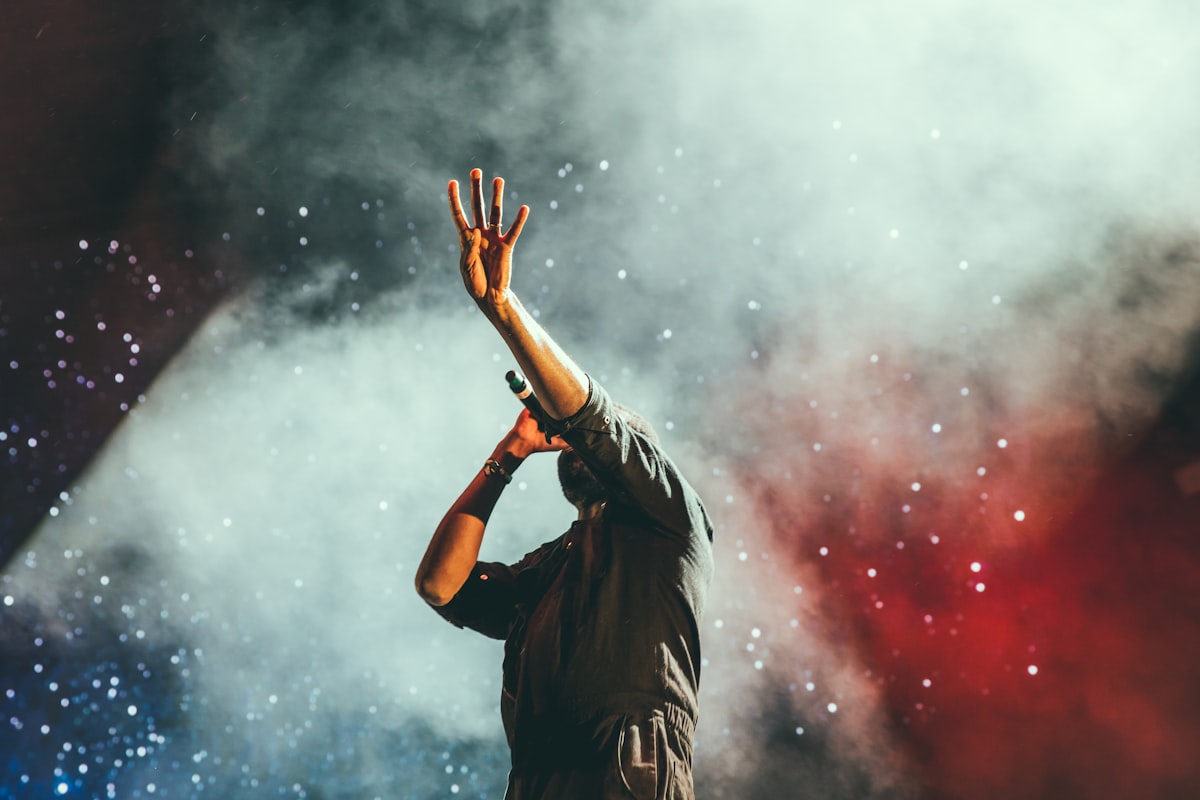
On February 1, Kendrick Lamar stepped onto the Grammy stage for the fourth time and walked away with five awards, surpassing Jay-Z as the most decorated hip-hop artist in Grammy history. Bad Bunny's "Debi Tirar Mas Fotos" became the first Spanish-language album to win Album of the Year. Billie Eilish and Finneas claimed their third Song of the Year win. The 68th Annual Grammy Awards delivered a night of history-making performances and cultural milestones that dominated social media for a week.
But if you're an exhibitor, the most valuable thing that happened at the Grammys wasn't any single award. It was the production itself. The 2026 ceremony was a masterclass in how to command attention in a room full of distractions -- which is precisely the challenge every exhibitor faces on a trade show floor. The techniques the Grammy production team used to hold 18 million television viewers and a live audience of 18,000 are directly applicable to booth design, and most of them cost far less than you'd think.
Lesson 1: Lighting Is the Cheapest Way to Change Everything
Every major Grammy performance this year shared one production element: dramatic, intentional lighting that created mood before a single note was played. Kendrick Lamar's performance used a stark single-spotlight approach that pulled the audience's focus to one point in an arena with 18,000 seats. Bad Bunny's set was bathed in warm amber tones that evoked a Puerto Rican sunset. The contrast between performances wasn't primarily achieved through set construction or pyrotechnics -- it was achieved through light.
On a trade show floor, lighting is the single most underutilized tool available to exhibitors. The default convention center overhead lighting is flat, fluorescent, and unflattering. It makes every booth look the same from a distance. Exhibitors who invest even modestly in their own lighting -- LED strip accents, spotlights on key products, backlit graphics, or color-temperature-controlled ambient lights -- create a visual distinction that draws the eye from 50 feet away.
The cost is surprisingly low. A portable LED lighting kit capable of transforming a 10x10 booth can be rented for $300-500 per show or purchased for under $2,000. For a 20x20 or larger exhibit, a professional lighting designer can create a custom scheme for $1,500-3,000 -- a fraction of the cost of structural upgrades that have less visual impact. If there is one takeaway from the Grammy production that every exhibitor can implement at their next show, it's this: control your light.
Lesson 2: Cultural Relevance Beats Generic Messaging
Bad Bunny didn't just perform at the Grammys. He made history by winning Album of the Year with an entirely Spanish-language record -- a first in the ceremony's 68-year history. The moment resonated because it reflected something genuinely happening in culture: the growing influence of Latin music, bilingual audiences, and cross-cultural artistic expression. It wasn't manufactured relevance. It was authentic, and the audience felt it.
Trade show exhibitors overwhelmingly default to generic corporate messaging: "Innovating the Future," "Solutions That Scale," "Your Partner in Growth." These phrases say nothing, connect to no cultural moment, and give attendees zero reason to stop walking. The exhibitors who command attention on the show floor are the ones who tie their messaging to something real and current -- an industry trend, a breaking news story, a regulatory change, a cultural shift -- and speak to it with specificity.
If you're exhibiting at a healthcare show the week after a major FDA policy change, your booth messaging should reference that change. If you're at a retail trade show during a period of record consumer spending, your materials should speak to the moment. The Grammy lesson is simple: the performances that mattered were the ones that reflected the world as it is right now, not the ones that played it safe with timeless but meaningless platitudes.
Lesson 3: Sound Design Creates Spatial Boundaries
One of the most sophisticated elements of the Grammy production was its use of sound to create distinct spatial experiences within a single venue. Each performance had its own audio signature -- not just the music, but the mix, the bass presence, the use of silence before dramatic moments. The production team used sound to create the psychological feeling of separate rooms within one arena.
On a trade show floor, sound is both a weapon and a hazard. Most exhibitors either ignore audio entirely or blast it at volumes that create a wall of noise. Neither approach works. What works is intentional sound design that creates a boundary around your booth space without assaulting passersby. Directional speakers that focus audio into a tight zone, ambient soundscapes that create a sense of entering a different environment when you step into the booth, and strategic use of silence during product demonstrations all create spatial definition.
The best booth audio experiences at CES 2026 used directional speaker arrays that were inaudible from 15 feet away but immersive at the demo station. This technology, once prohibitively expensive, is now available from companies like Holosonics and Brown Innovations for $1,000-3,000 per unit. For exhibitors in crowded hall environments, directional audio is the difference between a booth that feels like part of the noise and a booth that feels like its own space.
Lesson 4: The Power of the Unexpected Moment
The Grammy moment that generated the most social media engagement wasn't a planned performance. It was the unexpected: Kendrick Lamar's unscripted reaction when he surpassed Jay-Z's record, Olivia Dean's genuine shock at winning Best New Artist, the spontaneous standing ovation that interrupted Bad Bunny's acceptance speech. These unplanned moments created emotional peaks that no amount of choreography could manufacture.
Trade show booths are typically over-scripted. Every interaction follows a playbook: greeting, qualification question, product pitch, demo, lead capture. The predictability of this sequence is exactly why most booth interactions feel transactional and forgettable. The exhibitors who create memorable experiences are the ones who design for spontaneity -- live product customization that reacts to the attendee's input, real-time data visualizations that change with each visitor, unannounced product reveals that happen once per hour, or expert Q&A sessions where booth staff go off-script to answer the hardest questions in the industry.
Plan your booth structure. Script your key messages. But leave room for the unplanned moment that makes someone stop, react, and remember your brand three weeks later when they're making a purchasing decision.
Lesson 5: Consistency Wins More Than Spectacle
Kendrick Lamar didn't win five Grammys by having the most explosive single performance of the night. He won by being consistently excellent across multiple categories: Record of the Year, Best Rap Album, and a sweep of the rap categories. His dominance was cumulative. It was built on years of work, not a single viral moment.
The same principle applies to trade show exhibiting. The companies that generate the best long-term ROI from trade shows are not the ones who blow their entire budget on a single spectacular booth at one show per year. They're the ones who show up consistently, at multiple shows, with a professional and coherent presence that builds recognition over time. An exhibitor who does four shows per year with a polished 10x20 booth will almost always outperform an exhibitor who does one show per year with a flashy 30x30 island.
Consistency also applies to follow-up. The Grammy performers who convert cultural moments into album sales are the ones who follow up immediately -- new singles the next morning, social media engagement the same night, tour dates announced within 48 hours. Exhibitors who follow up with leads within 24 hours of the show close convert at 3-5x the rate of those who wait a week. The show is the performance. The follow-up is the album. You need both.
"The difference between a Grammy-winning artist and a one-hit wonder is the same as the difference between an exhibitor who builds pipeline and one who just collects badge scans: consistency, authenticity, and relentless follow-through." -- VP of Event Marketing at a Fortune 500 technology company
Capture Every Lead at Your Next Trade Show
Scannly replaces business cards with instant QR code contact exchange. Scan badges, share your info, and export leads in seconds.
Download Scannly FreeGet the Complete Exhibitor Toolkit
19 checklists, spreadsheets, email templates, and guides — everything you need before, during, and after the show.
Get Mega Bundle — $49.99$213.81 — Save 77%